



The Sushi Push Pop Viral Trend Has Taken Over India, But What Does It Say About Us?
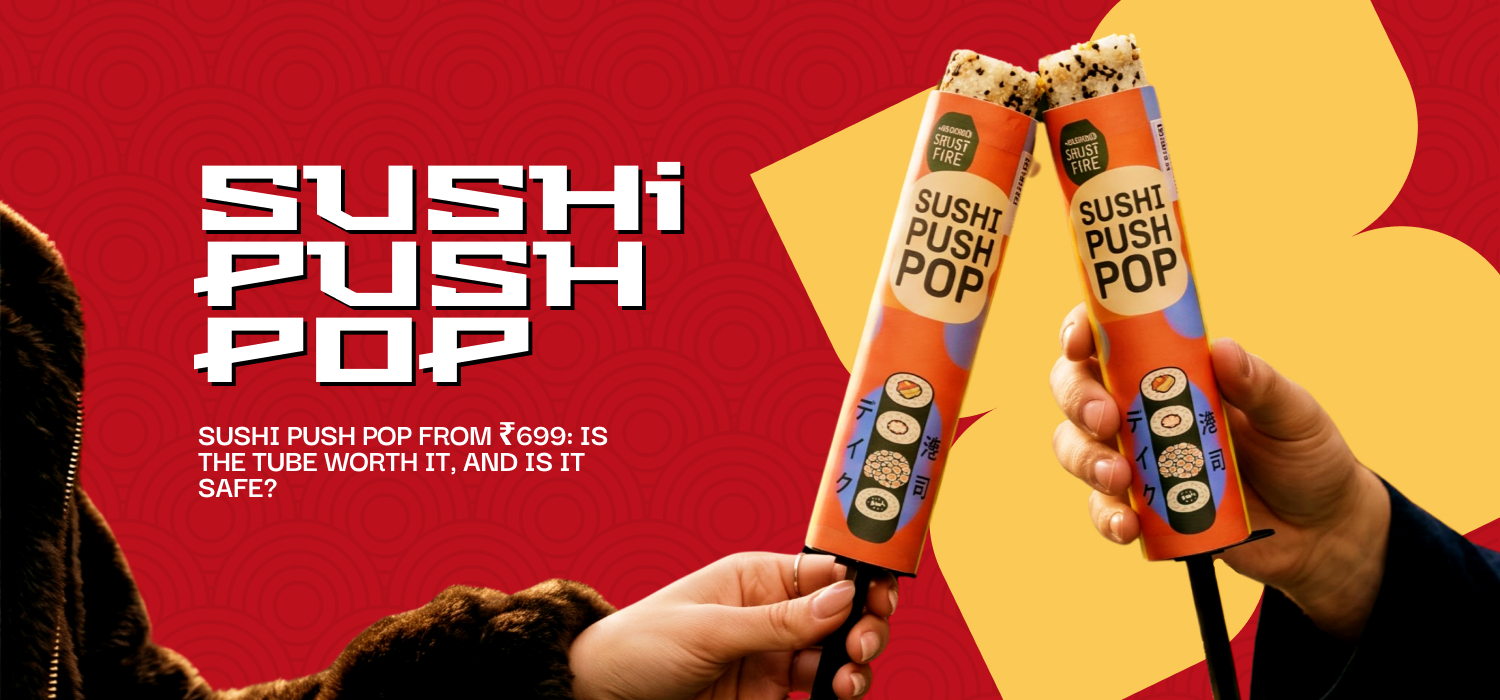
The sushi push pop looks like a childhood lollipop and eats like a maki roll. A cardboard tube holds the cut pieces. You push, you bite, you push again. No chopsticks. No tray.
It began in a small Manhattan shop and reached Delhi and Hyderabad within a year. I cook at home, and I study how food travels. This trend is odd because the recipe isn’t the star. The container is.
In my opinion, that raises three questions. What are you actually paying for? What’s inside the Indian versions? And is a roll sitting in a tube safe in an Indian summer?
Let’s take them one by one.
Quick Answer
A sushi push pop is a pre-sliced sushi roll packed upright in a cardboard tube, with a small soy-sauce tube you use to push the roll up one bite at a time. In India, prices start around ₹699 per pop. The format changes how you eat sushi, not what it tastes like. Eat it soon after it’s made, because sushi rice and raw fish both need careful temperature control.
What Is A Sushi Push Pop And How Do You Eat It?
A sushi push pop is a pre-sliced sushi roll placed in a cardboard tube. A smaller plastic tube filled with soy sauce sits beside it.
You use that smaller tube to push the roll upward, so each piece rises out of the top. The system copies the push pop candy, which lets you slowly push a lollipop out of a tube (AOL).
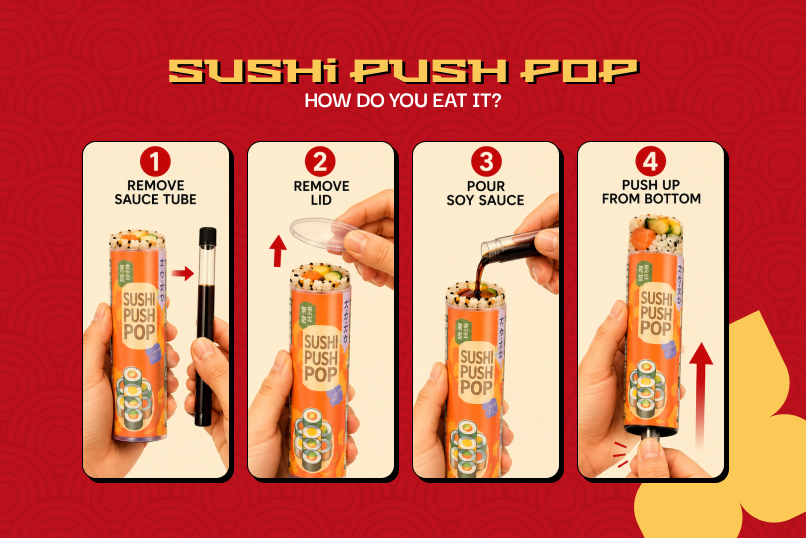
According to Secret NYC, eating one takes four steps:
- Pop the sauce tube off the side.
- Take off the lid.
- Pour the soy sauce in.
- Then push the sushi up from the bottom.
Indian versions also ask you to add wasabi or the soy sauce before you push.
As per the CSR Journal, the concept started at Suka Sushi, a compact eatery in Manhattan. The pitch is simple: sushi you can eat while walking, working or driving.
An Oklahoma City chef who sells them through a drive-thru says chopsticks can be a challenge for some people, as reported by News9.
Fair point.
But at a table, chopsticks still win. One reviewer who queued for a pop made the same argument, according to AOL News.
Where Did This Trend Come From?
The name is borrowed. As far as my research goes, Push Pop is an American candy brand made by Bazooka Candy Brands. The sushi version borrows the candy’s mechanism and its nostalgia.
And nostalgia is the best marketing technique.
Secret NYC opens its coverage with the ice cream truck push-up pop of childhood. That’s no accident. The tube makes adults feel like kids, and that feeling sells. But that’s my read.
Then came the spread. By March 2026, Spanish media described the “sushi pop” as a TikTok and Instagram trend reaching restaurants in European cities (Priego Digital).
According to NewsKarnataka, by April 2026, Delhi NCR venues such as Sticky Rice and Enoki were serving push-pop sushi. In June 2026, Saito Sushi in Gachibowli launched what Telangana Today calls Hyderabad’s first Sushi Pop. Its Bengaluru Bellandur outlet also lists them on Zomato.
A food trend that once needed a year to cross an ocean now needs a few months and a supplier. That detail matters, and I’ll come back to it.
What Does A Sushi Push Pop Cost In India?
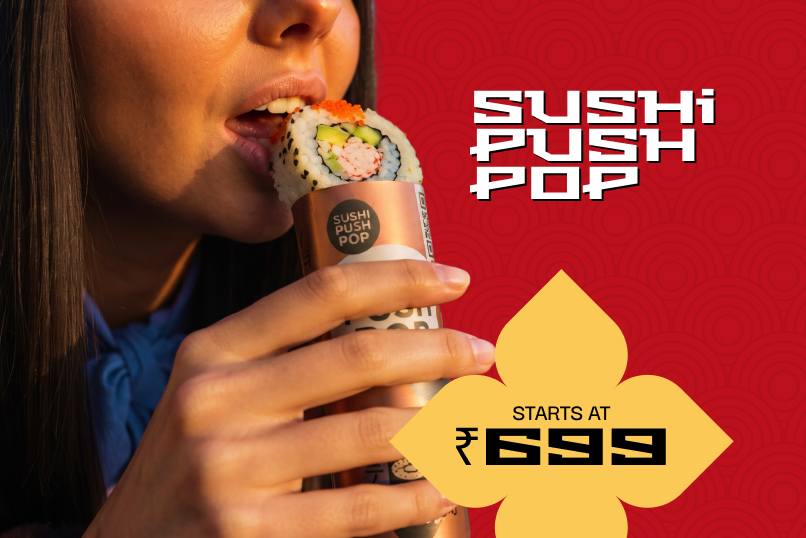
In a June Telangana Today report, Saito Sushi says its pops start at ₹699 each. Its Zomato listing labels several pops as four pieces. If that label means four pieces, ₹699 works out to about ₹175 a piece. That’s my math, so check the piece count before you order.
Big Sam’s lists a different product: a salmon-belly pop with 10 to 11 pieces for ₹995 to ₹1,200. That’s roughly ₹90 to ₹120 a piece. The page also says it isn’t available in every region. Same format, very different value per bite.
Abroad, a Houston shop lists its push-up rolls at $14.99, as reported by Toast. And the Chicago White Sox charge $23 for theirs at the ballpark, according to WGN.
So, I would say it’s best that you don’t compare a sushi push pop by sticker price. Rather, compare it per piece, then check what’s inside. Because, let’s be completely honest, a salmon-belly roll and a tempura-and-mayo roll aren’t the same product, even in the same tube.
Is It Real Sushi?
The format is new. The Indian fillings are mostly familiar. For instance, Saito’s menu on Zomato lists Veggie Crunch, Creamy, Rainbow, Crunch Chicken and Shrimp Tempura pops. Those names point to cooked, crunchy, and creamy fillings, not raw fish.
That fits a long Indian habit.
Short-grain sushi rice has been hard to find in India, and kitchen managers say that pushes restaurants toward localized versions (SCMP).
According to an article published on Open Magazine in 2009, Japanese residents in India have said ham, cream cheese, and mayonnaise don’t belong in authentic sushi.
In my opinion, I don’t think that makes Indian sushi fake. I think it makes it Indian.
Business Today’s International Sushi Day 2026 piece says India has moved from accepting sushi to being choosy about it, with some diners paying ₹25,000 for an omakase. The push pop sits at the other end of that range: cheap, fast, and made for social media. NewsKarnataka sums it up well. The trend is less about new flavor and more about a new way to eat.
Vegetarians have options. Saito’s listing includes veg pops. The founder of Sushi & More says his company makes Jain, veg, and non-veg sushi, according to LuxeBook.
The Tube Is The Product
This is what I genuinely want to talk more about. A sushi push pop didn’t become viral as a food. Rather, it became viral as a product.
Suppliers sell the tubes in bulk. One European seller, Sushipop, lists them from ?0.39 each and claims more than 600 million TikTok views for the format. Another manufacturer says it has made 9.8 million custom tubes for more than 253 brands.
Now, these are supplier claims. But the point holds.
Any kitchen can order tubes, pack its existing maki, and sell a “viral” item. I think that explains why cloud kitchens adopted it so fast. That’s my inference.
Compare it with the 2022 sushi bake. That was a home recipe. A creator posted it in December 2021, and the hashtag passed 119 million views, as reported by Bustle. Anyone with a baking dish could join in. The push pop needs packaging. That shifts the trend from home cooks to restaurants and suppliers.
As a home chef, I notice that shift.
Is It Safe To Eat?
Sushi isn’t a low-risk food. Rice at room temperature is a friendly place for pathogens to grow, and raw fish can carry bacteria and viruses. Vinegar is the safety control for the rice, because it lowers acidity.
Ireland’s Food Safety Authority says rice should be acidified straight after cooking to a pH of 4.6. Properly acidified rice can then sit at room temperature for a maximum of four hours. Australian guidelines define temperature control as keeping food at 5°C or below where needed.
Now apply that logic to sushi push pop in India. A sushi push pop is a sealed tube. It may ride across a hot city in a delivery bag.
My reading of these rules is that the clock starts when the rice is made, not when you open the tube.
Applying this to India, the FSSAI’s latest cold-chain mandate makes handling these items incredibly strict. In October 2026, the FSSAI issued a strict nationwide directive warning food business operators (FBOs) against “temperature abuse” during transport and distribution.
While a push pop’s sealed tube blocks external dust, it creates a humid greenhouse inside a delivery bag crossing a hot Indian city. The safety countdown begins at production, not delivery.
Also Check: Dubai Chocolate Is Viral On IG. Is It Just Sewai And Pista, Or Something Else?
Should You Try The Viral Sushi Push Pop Trend?
I love food. So, I will not warn you against trying this viral food trend. However, you need to keep a few things in mind. Here’s what I would advise:
Practical Checks:
- Ask when it was made.
- For long trips, pick cooked or veg fillings over raw fish.
- Eat it soon after it arrives. Don’t leave it in a bag.
Try a sushi push pop if you want a fun snack. As Soham Sinha, a popular food blogger from Kolkata, rightly calls it, “it’s literally sushi you cancarry anywhere.”
You’ll eat it fast, and the filling is cooked or veg. Skip it if you want to judge a kitchen’s fish, if it has a long delivery ahead, or if the listing gives a price with no piece count.
Sushi was street food first. Hanaya Yohei sold it from street stalls before opening his own shop. An Open Magazine feature says sushi’s creator in Japan always imagined it as fast food, even for roadside eating.
So the tube isn’t betraying sushi. It’s going back to its roots. The reverent sushi counter came later. That’s my argument.
In my opinion, the sushi push pop isn’t a new food. It’s an old one in a new costume. Order it for fun. Check the piece count, ask when it was made, and keep your chopsticks for the serious stuff.
Additional Resource: Food Creators Have Given The Kunafa Dessert A Desi Twist, And We’re Here For It.


